Single Mode vs Multi Mode FORJs: What’s the Difference and Which Do You Need?
When researching Fibre Optic Rotary Joints (FORJs), a common question for engineers and technical buyers is whether to choose single-mode or multimode fibre. You’ll also see specifications talking about single-channel and multi-channel designs, which can add to the confusion.
This guide explains the differences, what they mean in practice, and how to pick the right option for your application.
What is a FORJ?
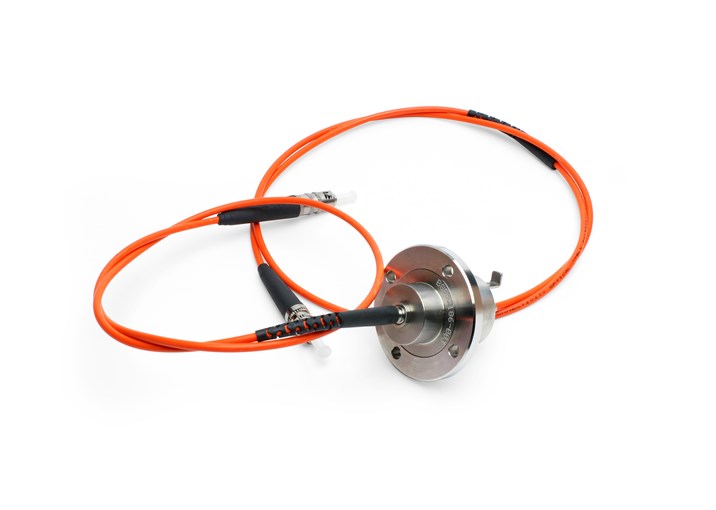
A Fibre Optic Rotary Joint lets optical signals pass across a rotating interface, maintaining continuous transmission between stationary and rotating parts. You’ll find FORJs in wind turbines, medical imaging systems, drones, robotics, defence platforms and subsea equipment.
Single-mode vs multimode fibre
The key difference is how light travels through the fibre core.
Single-mode (SMF)
• Core: ~9 μm
• Behaviour: Light travels in a single mode (path), giving minimal dispersion.
• Performance: Very low loss over long distances; suited to high bandwidth and long links (tens of kilometres).
• Typical uses: Telecoms, subsea links, aerospace and defence where distance and signal integrity are critical.
Multimode (MMF)
• Core: 50 or 62.5 μm
• Behaviour: Multiple modes bounce within the core, increasing modal dispersion.
• Performance: Higher loss over distance; best for short links (from ~100 m up to ~2 km depending on grade and data rate).
• Typical uses: Data centres, medical devices and industrial systems where short-range, high-throughput links are needed and ease of alignment is valuable.
Single-channel vs multi-channel FORJs
A single-channel FORJ carries one fibre. It’s typically compact and light, ideal where space and mass are at a premium (drones, robotic joints, handheld medical devices).
A multi-channel FORJ carries two or more fibres simultaneously. It suits systems needing higher aggregate throughput or multiple, separate data paths (wind turbines, offshore platforms, defence systems, simulators).
Combining the options
Single-mode or multimode can be used in either single-channel or multi-channel FORJs. Selection usually hinges on:
-
Distance – Long runs favour single-mode.
-
Bandwidth & integrity – When performance margin matters, single-mode excels.
-
Cost & simplicity – For short links and tighter budgets, multimode is often the practical choice.
-
Data architecture – Multiple streams or segregated links point to a multi-channel FORJ regardless of fibre type.
Which is “better”?
There’s no universal winner.
• Choose single-mode for long-distance, high-performance, low-loss links.
• Choose multimode for short-range, cost-effective, simpler integration.
• Choose single-channel for compactness.
• Choose multi-channel when you need multiple independent fibres through the rotary interface.
How BGB can help
No two systems are identical. BGB designs and manufactures custom FORJs to fit your exact requirements—single-mode or multimode, single-channel or multi-channel. If you’re unsure what you need, our engineers can recommend the right combination for distance, data rate, size and budget.
Conclusion
Focus on distance, data needs, size constraints and budget. With the right guidance, you can specify a FORJ that delivers the performance and reliability your system requires.
To discuss your project or a tailored solution, contact the BGB team.
FAQs
What is a single-mode fibre FORJ?
A FORJ designed for single-mode fibre. It uses a very small core and a single propagation mode to provide long-distance, high-bandwidth, low-loss transmission across a rotating interface.
Can a FORJ support both single-mode and multimode fibres?
A single-channel FORJ carries one fibre type only. Multi-channel FORJs can mix fibre types across different channels if required.
How many channels can a FORJ support?
BGB supplies FORJs from one channel up to 20+ channels, depending on the application.
Which FORJ is most cost-effective?
For short-range systems, a multimode single-channel FORJ is usually the most economical choice.
Visit the BGB website for more information on Single Mode vs Multi Mode FORJs: What’s the Difference and Which Do You Need?
ENQUIRY FORM